Investing: Look Through the Clouds and Focus on the Long Term

We always state that an investment is a means to an end, it is not the end goal. You don’t invest so you can have an investment, you invest so that you can achieve a goal such as to improve your lifestyle, to secure retirement income, to buy a house in the future, or to fund lifestyle choices such as travelling.
When looking at investment markets and portfolios it is important to do that through the lens of your objectives. This is why we describe our service at Black Swan Capital as objectives-based advice. We are focused on your aspirations and the portfolio composition that we recommend is a reflection of your goals; the investments are the tools that help you to get there.
Over the last year we have written a number of articles about managing your portfolio, and importantly, managing how you feel about your investments, in times of market volatility and global uncertainty. We have also written about the varied pressures on the global economy and the possible outcomes of different triggers of market corrections.
We know it is difficult to remain focused on your long term goals when the news cycle is full of stories about how the world is changing, market pressures and risks of recession, conflict, inflation and market corrections.
In this article we focus on two long term views of investment markets that may help to reconcile this pressure between short term constant news pressures and your long term goals. The purpose is to keep you informed, to help you understand how we view these many market impactors, and to guide you towards making the best decisions for your circumstances. If you are interested in financial market analysis as we are, you might enjoy this information.
Longer term reduces volatility
First, we look at the comparison between annual returns of the global stock markets, and the maximum drawdown within each year. The reference for global stock markets is the MSCI world index. There is an important message in this graphic representation of this data: do not react to short term news.
What it is showing is that within a given year markets will rise and fall day to day. Their low point (or high point) within a year will not necessarily reflect the full year returns. The graph is sourced from the JP Morgan Q2 2026 Guide to the Markets (https://am.jpmorgan.com/nl/en/asset-management/adv/insights/market-insights/guide-to-the-markets/).
To look at an extreme example in the graph, the full year 2020 return was 12%, but the lowest point in the year was negative 33%! It is a reinforcement to not sell when markets fall.
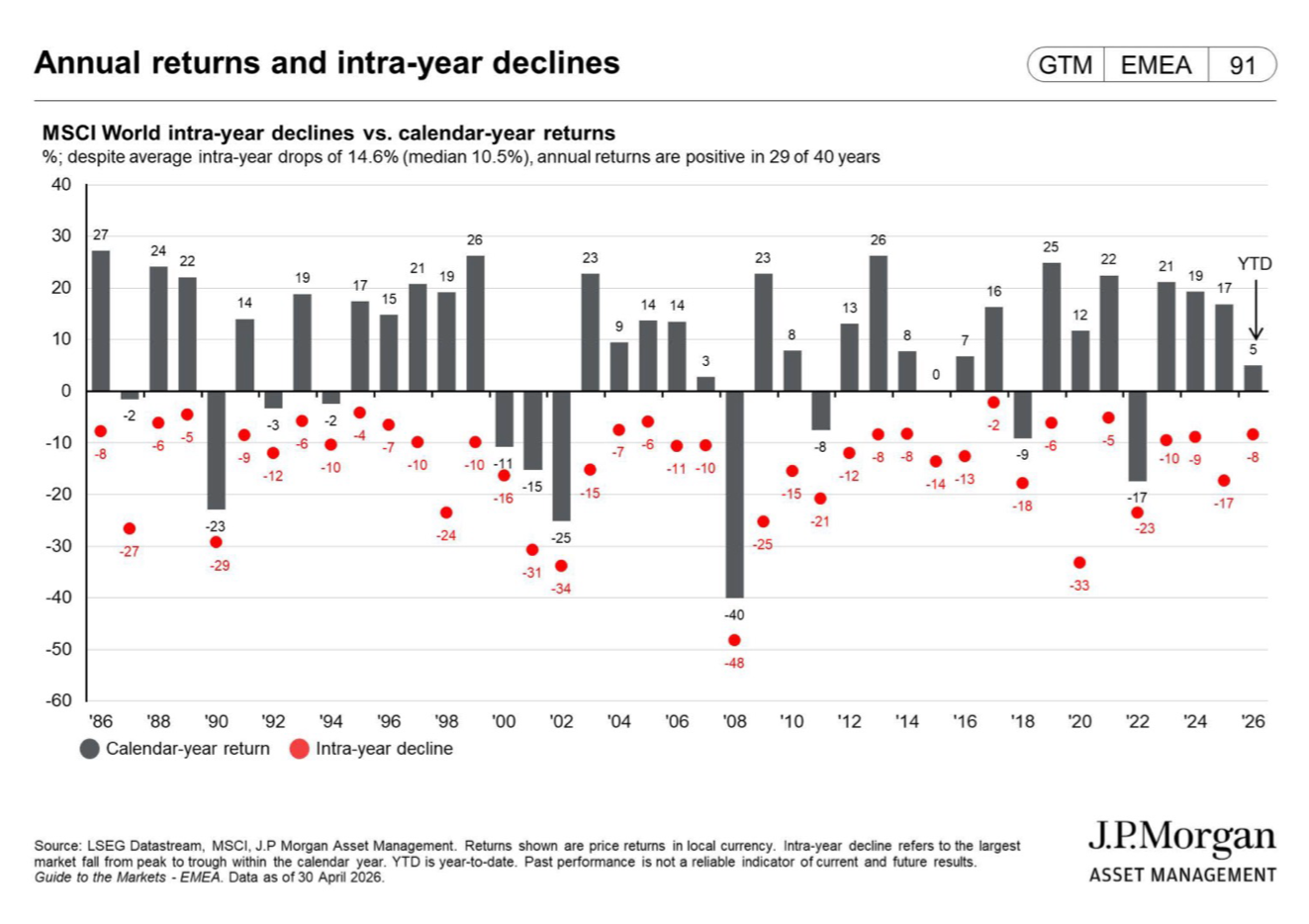
Another way to describe this is that markets go up over time but not in a straight line. Over time, volatility and risk of a negative return reduces- there is a greater chance of a negative return over 1 day than over 1 year.
Staying the course will be better than reacting to negative news, a useful reminder in times of uncertainty. And if you are unsure, speak with us at Black Swan Capital.
Timing the market - it’s nearly impossible and expensive if you get it wrong
Second, we look at compounding returns over time of stock markets and show how that compares to the investor that moves in and out of a market and (inevitably) misses the best days of the stock market.
The magnitude is startling. We are talking about missing only 10 - 30 days out of more than 10,000 days!
The following graph is produced by Hartford Funds (www.hartfordfunds.com).
The core message is that timing the market is almost impossible. The pie chart on the left shows that the best days in the market are not necessarily in market rallies. They state that this counts for only 24% of markets’ best days. Nearly half of these best days occur in negative (in financial jargon called bear) markets.
The main chart shows the impact of missing key market days. Missing just the best 10 days in the US stock market between 1996 and 2025, may result in a return that is 56% less than the investor that remained in the market! 56%! If you miss the 30 best days of the last 30 years, your returns could be 84% lower!
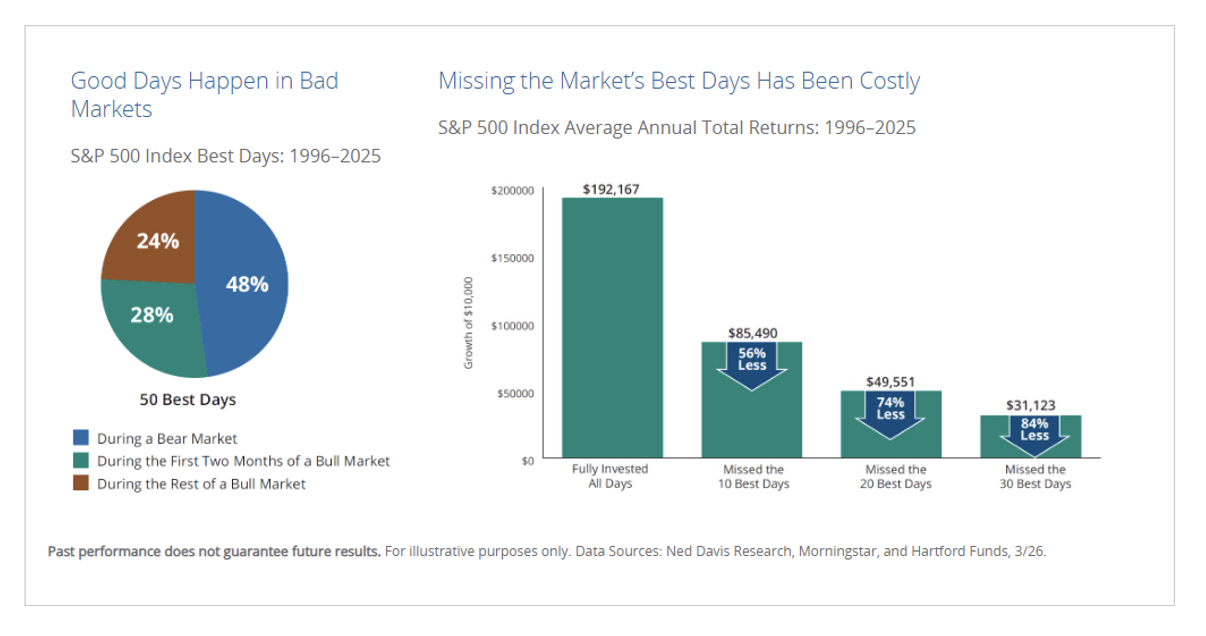
What does this tell us? It reinforces that whilst we always say it is virtually impossible to time the market, meaning sell and buy at the ideal time, if you do not time it exactly write and do miss even a few of the best days because you were selling at the wrong time or buying back in too late, your returns may be profoundly lower. Matching your investment management approach to the timeframe of your goals can mean greater total returns.
Importantly this does not mean being passive. It will be essential to make portfolio adjustments over time. It does mean not being reactive.
Markets are complex, changing and their movements can be emotionally challenging, even draining. That is why we recommend you speak with us at Black Swan Capital. A perspective and approach that is built around your specific goals, and an ongoing management and formal assessment can help you to make the best decisions for you, to give you peace of mind and remove this potential risk.