Which Way is Down: Preparing for the next crash

Black Swan Events. If our company name triggers associations with Nassim Taleb’s concept of anti-fragility and the predictably unpredictable, that is by design, but that’s not to say that we at Black Swan Capital are constantly kept awake by the fear of the next disaster. We want our clients to be prepared to defend against negatives and benefit from positives, but trying to guess what comes next can often be more harmful than helpful. The current global economic situation is a perfect case in point.
Competing principal threats. Diametrically opposed defensive requirements. Wildly contrasting potential outcomes.
Very often, the only way to defend against potential downturns is to diversify in-between them. Sometimes, this can feel like ignoring the headwinds, but it is frequently the best way to prepare through uncertainty.
For today, we will consider four principal threats that are overlapping, occasionally competing for headlines and constantly competing for the attention of asset managers and investors in much of the world right now.
Return to higher inflation
AI and tech bubble
Energy crisis
Consumer debt
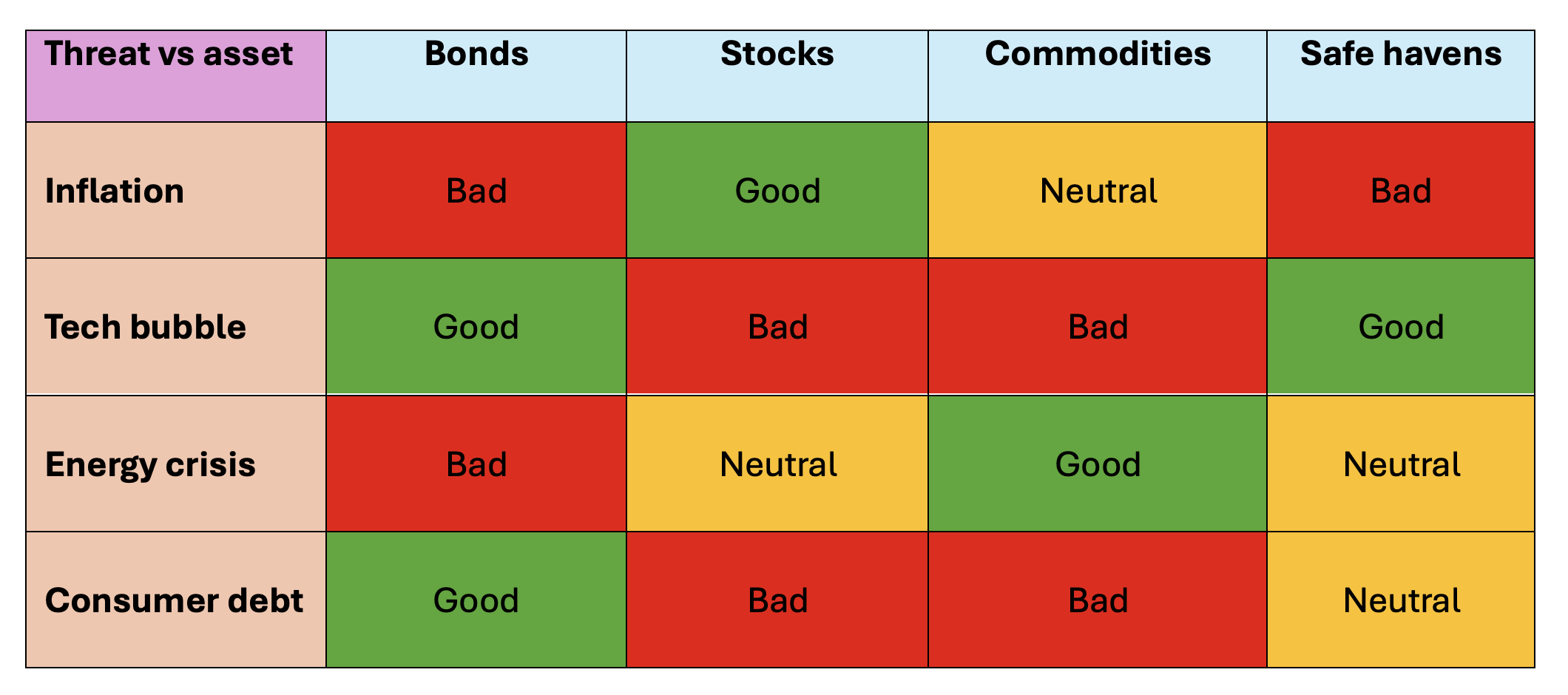
This table is an example of how different asset classes might react to each of these four competing threats.
As the table shows, each of the threats we are considering in the current market holds significant risks for certain assets, and opportunities for others. For example, the ongoing conflicts in the Middle East and eastern Europe that are fueling (pun intended) a new energy crisis could also drive higher inflation. Both of these effects are likely to harm the fixed interest market, but if inflation is a problem, then cash and some other safe havens could suffer, but the assets that will benefit depend on whether production, fuel and logistics costs or consumer demand and government spending are driving up the prices.
On the other hand, a consumer credit crunch, which has largely been ignored by the media while more explosive (again intended) matters grab the headlines could be as damaging as a tech collapse, but with different outcomes for different assets. Both would harm stock markets and particularly the financial sector, but a debt crisis may lead to more government spending or bailouts and inflation, while an AI bubble could push consolidation and a rush to safe havens.
Of course, this is a massive over-simplification and will vary between regions individual assets and other variables, but it serves to illustrate the difficulty in trying to predict a future downturn.
And that doesn’t include all the eventualities we haven’t thought of for this article.
A black swan event could turn your golden goose into a sitting duck.
So how do we navigate this sort of uncertainty as investors?
Firstly, we need to recognise that this is not a new situation. There are always competing threats and opportunities in the world. Our modern, information-saturated world has certainly made them more accessible and they can therefore seem much closer to home, but anyone who says “This time it’s different” was probably not paying attention last time.
The only correct answer is in two parts:
Focus on your objectives.
If you are savings and investing over 30 years, global economic crises will upset your metaphorical apple cart for a few of them. The key is to understand that our financial world moves in cycles, and recovery periods are historically longer than downturns, so there are always opportunities that follow difficult times, regardless of causes and effects.
Diversify.
Current affairs and market conditions will always be competing for your attention and there will be loud voices on all sides that claim to know which new thing is the shiniest and which monster is the scariest. Some of them are right, some of them are wrong, but nobody has the answer every time. It is important to make sure that your investments are not tied to one projected scenario. Hold different assets, avoid over-concentration and maintain flexibility where possible.
Staying objective where your money and your future is concerned can be incredibly difficult, so your financial advisor should be talking to you about how to keep emotions like fear and greed out of the decision-making process. If you are worried about your investments, it might be reassuring to hear that your portfolio is well-diversified and built for long-term success, or it might be a sign that you should reconsider your targets, timescales or risk profile.
Always remember that any portfolio is a vehicle for a particular journey, and every journey can encounter difficulties, delays and diversions. Speak to your financial advisor about how to make sure that your financial plans are well-diversified, anti-fragile and ready for every eventuality.